Daniel Radcliffe and I Are Now Married
A Unique Experience at the Hudson Theatre
I hadn’t anticipated getting married to Daniel Radcliffe. But as my friend and I located our seats for Every Brilliant Thing—the solo hit by Duncan Macmillan, with Jonny Donahoe, that’s been trekking from Fringe circuits to regional theaters to big commercial productions over the past 13 years—there he was, crouching in Row H, chatting with a couple whose seats were next to ours. The Hudson Theatre was buzzing with more than the usual preshow energy. Macmillan and Donahoe’s play runs on consensual audience participation, and in the lead-up to go-time, Radcliffe and a number of crew members were scuttling around the auditorium, shaking hands and recruiting willing members of the public to help him out, when called on, with various bits of the show. Suddenly he popped up and spun around. The friend I was with is an actor. We must have smelled like theater.
“Hi! I’m Dan!” said this quite famous human. “Would you mind playing my love interest?”
I confess: I couldn’t turn him down. But before we get to my Broadway debut, some context.
Every Brilliant Thing evolved from a short monologue called “Sleeve Notes” that Macmillan wrote for a friend, the actor Rosie Thomson. (In the present-day version—a zippy 70 minutes—the act of listening to records while poring over the liner notes is a profound part of the unnamed narrator’s love language.) Over the years it expanded, with the eventual collaboration of the comedian and performer Donahoe, plus some Facebook crowdsourcing, into a play that fully fleshed one of the original story’s key ideas: That’s the list of the title, a tally of “everything brilliant about the world.”
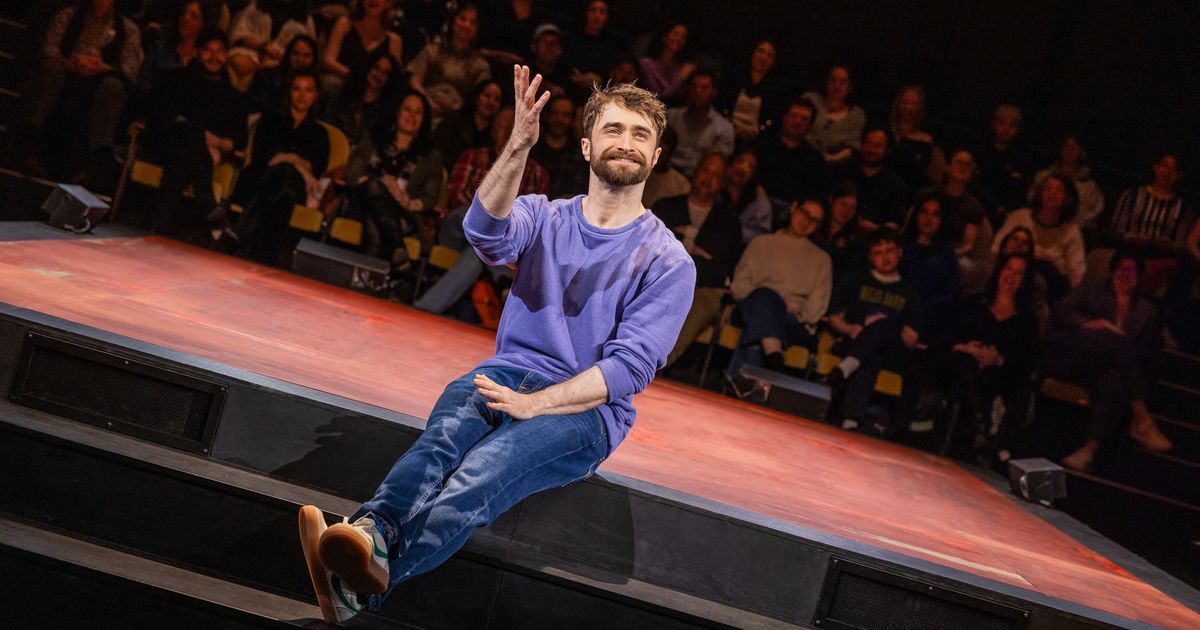
When the show at the Hudson begins, it’s with a sharp click—the preshow underscore of upbeat, noodling jazz snaps into silence as Radcliffe is suddenly highlighted on a central platform with blocks of audience on all four sides (three on the stage, plus the usual seats in the house) to speak his first line: “The List began after her first attempt.”
If Every Brilliant Thing—a show with a well-meaning didactic streak, about depression, suicide, and the effort to remember “everything worth living for”—were an American play, it would likely be insufferable. We’d boil it into sentimental goo. What turns it, instead, into quite a lovable play is its Englishness. There’s a moment in the story’s latter half when the narrator, who has long balked at therapy, finally gives it a try. He introduces himself sheepishly to his support group: “This is my first session. I’ve resisted doing this. I’m — you know … British.” Just those extra few centimeters of distance, the value placed on wit and speed, the aversion to wallowing (a word that has deeply offended the narrator earlier in the show)—all these go a long way toward keeping Every Brilliant Thing on the right side of the line between buoyant and cloying, between inspiration and inspo.
The Power of the Performer
What has the real power to cinch things, however, is the performer. To carry Every Brilliant Thing, an actor needs to combine character with the caffeination and pivoting skills of stand-up, plus a conductor’s grand sense of organization and tempo to handle the crowdwork. As we follow the narrator from childhood—his mother’s first suicide attempt came when he was 7—into self-definition, love, loss, therapy, and beyond, the list punctuates it all. Dozens of audience members have been handed cards during the preshow with numbered brilliant things on them. When Radcliffe calls out a number from the list, the card holder has to shout their entry back. “Three hundred and 15!” says the narrator. “The smell of old books!” someone hollers in reply. “Three hundred and 16!” “Michael J. Fox!” “Three hundred and 17!” “Toasted-sandwich makers!” Or say an audience member is pulled into service as the narrator’s guidance counselor, or his dad, or a college professor holding forth on The Sorrows of Young Werther (or, cough, his love interest), and they need a little encouragement, or they get tongue-tied, or they say something out of left field. All the old improv muscles have to come into play.
Say “yes”; stay flexible; catch the ball, throw it back.
A Perfect Fit for the Role
A Broadway outing for Macmillan and Donahoe’s play was always going to have a big name at its center, and given that, it’s hard to imagine a better performer for the material than Radcliffe. And I’m not just saying that because we’re married now. He’s a human ping-pong ball, a fizzing sparkler, a genuinely effervescent, generous, and curious individual whose dynamic is less Former Star of $35 Billion Media Franchise and more Adorable Nerd Who Just Asked You To the They Might Be Giants Show. At the same time, his charm isn’t hapless or floppy—it’s given crispness and integrity by a quick brain and an apparently sound heart. When the audience member Radcliffe had tapped to play his school counselor couldn’t quite figure out how to tell an impromptu joke, he ad-libbed to the audience: “Mrs. Patterson was known for her surreal sense of humor.” Later, in his interaction with me, he borrowed a book from someone else in the crowd—an edition of Twilight old enough to have a sticker on the cover declaring “Soon to be a major motion picture!” “Wow, looks like it’s going to be a movie,” Radcliffe quipped as he handed me the book. Then, after the tiniest beat: “Nothing ever goes wrong when they make books into movies.”
Notably, the show doesn’t need to be done by a man, and the actor is able to pick someone of any gender to play their great love, Sam, and to adjust the story’s pronouns accordingly. Radcliffe has invited male and female Sams onstage during previews. That’s one of those small-but-not-small things, and it—along with the play’s central mission—resonates with how the actor has chosen to use his time and resources beyond the camera and the curtain. He does regular work with the Trevor Project and has stood his ground, kindly but firmly, in opposition to J. K. Rowling’s determination to die on the hill of transphobia. Meanwhile, returning to the stage at all—let alone in a Fringe-born, improv-heavy show with a commitment to the discussion of mental health—slots right into the list of earnestly cool creative decisions Radcliffe has made post-Potter. There aren’t many people who can truly do what they want, and Radcliffe is a nice reminder that some people do in fact want to do good or at least adventurous things. Before he won a Tony as Charley Kringas, he played a young Bulgakov, a young Allen Ginsberg, and a young Weird Al—also Tom Stoppard’s Rosencrantz and a flatulent corpse. The point is, he’s succeeded in making hay of the fact that he may never quite disappear into his roles. Instead, he twinkles through them, and his joy in the work is contagious.
A Love Story Unfolds
But what about your marriage?! I hear you holler. Well, we met in the college library. He lent me Twilight and I lent him Percy Jackson and the Olympians. (We were into YA, I guess.) He took me to meet his parents, who seemed great—they played and sang jazz around the piano. His mother was bright and funny and dramatic, though I know that’s only one side of her, and I saw how scared he was for her. I proposed (I know!). People threw confetti at our wedding, and his dad made a wonderful toast. And this is the potential of Every Brilliant Thing: Though it can stray into PSA territory, you can never really resent it because then a shy-seeming, silver-haired stranger stands up and actually starts to cry as he tells you and Daniel Radcliffe how much he loves you and how beautiful you are together. In its essence, it’s a play about presence and attention, about how really noticing the world might just be what saves us.
Every Brilliant Thing is at the Hudson Theatre.


